The way customers find culligan has changed. Are you ready for it?

In May of 2026, Google rebuilt its search box for the first time in 25 years. If you click “AI Mode”, the familiar list of blue links is replaced by an AI-powered box that answers questions, holds a conversation, and hands the user a finished answer instead of a page to click on.
Google’s own AI Mode crossed a billion monthly users this spring, which was announced at Google’s I/O summit. This is the biggest hinge point thus far in a shift between Google search, and AI Chatbots such as ChatGPT, Gemini, Claude, and Perplexity. It signals a fundamental change in the ongoing saga on where, and how, people find information on the internet.
“Is this going to get me more organic leads?”
Short answer: yes — if you invest in the whole picture, not just a website with your products listed on it.
The big picture is worth investing in at the local level. The search market is over $300 billion today and according to Strategic Market Research, is expected to more than double over the next decade. The primary reasons for this from a Culligan perspective boil down to this:
- More people are looking for answers online than ever before. The option given to search for answers on a traditional search engine OR an LLM-style prompt has split the search market into factions. However, the number of total users in these channels (many who are current or future potential customers) has experienced massive growth. Google AI passed one billion monthly users in its first year, with queries more than doubling each quarter since launch.
- A shift in consumer preferences. It’s no secret younger generations are more likely to use phones and digital platforms as a source of information. Gen Z sits at around 76% usage for AI, the highest of its category, and millennials are second at 58% (Deloitte 2025, US). As each year passes, it’s inevitable these cohorts are moving from emerging to core audience for Culligan as they advance their careers, start families, gain more buying power, and become homeowners.
- Core audiences are joining the bandwagon. AI is now spreading to the older, higher-equity buyers who still dominate current purchases (NAR’s 2025/2026 Generational Trends Report), expanding the total search + AI prompt activity and bringing answer-engine behavior to the exact audience Culligan wants to see contacting them.
But how a lead reaches you is the part worth understanding, because what used to work no longer tells the whole story.
How A Lead Reaches You
| Then (traditional search) | Now (AI-shaped search) | |
|---|---|---|
| Where learning happens | On your website — blog posts, service pages | In AI answers, AI Mode, Reddit, YouTube — before they ever reach you |
| The first click | High-funnel: “is my water hard?” lands on your article | Often skipped — the answer engine handles it on the results page |
| Visitor intent on arrival | Mixed — researchers and buyers blended together | High — they’ve done their learning elsewhere and arrive ready to act |
| Conversion behavior | Lower rate, higher volume | Higher rate, lower volume — BAM data: AI-source visitors convert at 4x organic search |
| Visibility of the path | Trackable end to end in analytics | Largely invisible upstream — the path got longer and harder to trace |
| What wins | Ranking #1 for the keyword | Being the source AI cites, plus presence in the rooms where learning happens |
How The New (Old) Search Format Is Designed To Funnel Users Away
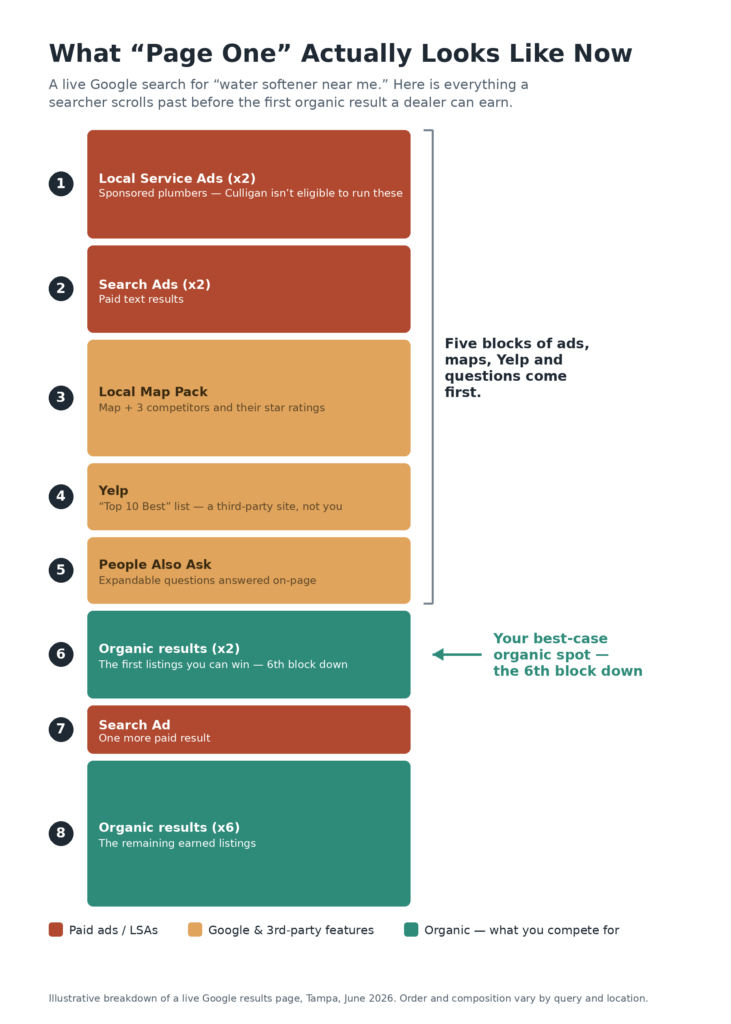
A simple local search (not using AI mode) drives fewer clicks by default. Here is an example for “water softener near me” in a local DMA. This is the first page of the search results. You have, in order:
- Two local service ads (LSAs). Culligan is not eligible for these as of June 2026, plumbers in this space are siphoning leads at the top of the search page.
- Two ads
- The local Map Pack with Google Business Profile listings
- Yelp
- People Also Ask (FAQ designed to keep users on Google results page)
- Two organic search results
- Another ad
- The last six organic search results (Culligan corporate site is in this mix).
This means that grabbing the top rank is not what it used to be. The top ranked result, in this case, is actually a listing in the map pack, which heavily favors distance (which is out of your control) over relevance and authority, or the 6th or 7th option listed.
Many Users Are Now Taught By AI And Come To Your Website To Convert
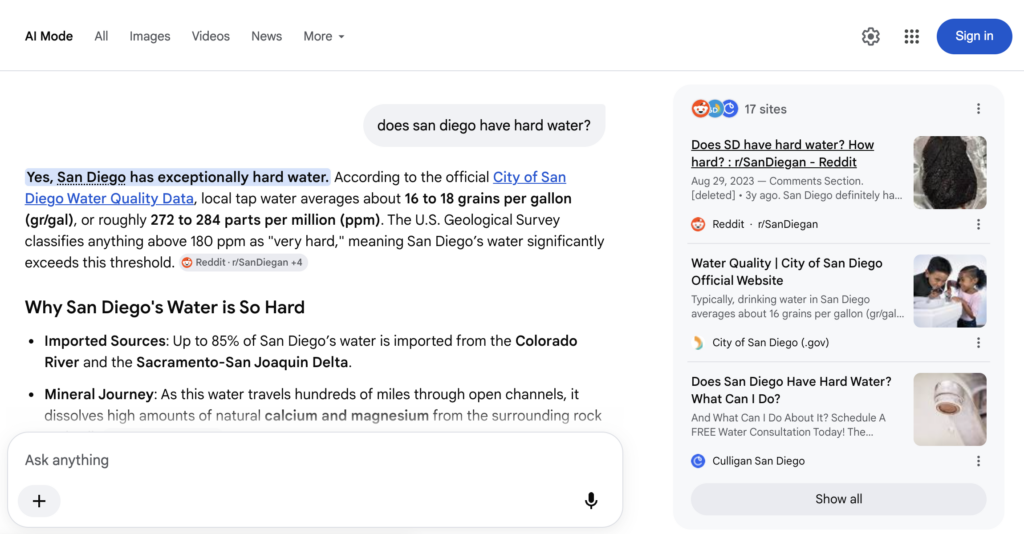
The high-funnel informational searches like “is my los angeles water hard,” “do I even need a softener in los angeles,” “is my los angeles tap water safe to drink” used to happen through Google, and then in a website. Today, an answer engine handles more of that. Google answers it right on the results page, leaving less of a reason to click through. The customer learns most of what they need before they ever click.
That sounds like bad news, and every content publisher from your end of the world to the other is displeased by this development. But let’s look at it through a different lens and focus on what we can control: By the time someone reaches your site or picks up the phone now, they’ve already done their learning somewhere else. So, the visits you do get have more intent than ever before. This is backed up by BAM’s own research: across more than a dozen local Culligan websites, conversion rate from AI sources (ChatGPT, Claude, Gemini, Perplexity) was quadruple that of a typical organic search channel.
The nuance here is the learning that shapes that decision now happens in places you don’t own and can’t fully see to understand. And much of it is invisible to the tools we’ve always relied on. The path to your lead isn’t gone, it just got longer and harder to trace.
So Where Do You Need To Show Up?
- Your own content – both local and generic. This sounds paradoxical after the last paragraph, but it’s not. Water is local. The customer asking about hard water in their town wants an answer about their town, the real water quality, the local conditions, the things only a local government site or water treatment expert would know. Generic content still matters to establish your site as an authority in the eyes of LLMs and Google. Put aside optimizing for robots for a second. Supportive content about, for example, softeners versus filters and what the difference is between them, is helpful content for your users. Additionally, citations (local directories), mentions, and brand visibility are still very important, even if the number of page views may diminish.
- Off your website. According to Datos/SparkToro “State of Search” Q1 2026, Reddit is the #2 place Americans go after a Google search — ahead of Facebook — and YouTube is #1. Your reviews, your Google Business Profile, Yelp, the neighborhood Facebook and Nextdoor groups, even YouTube. In an era of robots, people crave authentic human experiences and take recommendations from their online community. These are the places leads are generated more than ever. If a competitor is present in these spaces with good consumer sentiment and you’re not, the lead becomes theirs. Backlinks and mentions still do matter anywhere a search engine indexes them, including social media. Invest in community leadership initiatives and sponsorships that give the local brand positive visibility. If you’ve done something newsworthy, reach out to local media or run a news release.
- Paid. Google Ads still work, and they do their best work supplementing the other two by catching the ready-to-buy searches while your owned and earned presence builds the trust that makes the click convert. Ads are not part of the measurement discussion, as UTM tags are more easily trackable, and this is where we want to track our leads and ROI efforts in a more linear fashion.
How Do We Measure It When The New Path Is Less Visible?
Leads still get counted the way they always have: calls and form fills. That doesn’t change. What changes is everything upstream — so we watch leading indicators that tell us the what is working before the phone rings:
- Branded Search Volume: Culligan + location searches over the course of time show interest in your brand. We can track all geographical search volume to get leading indicators of local brand health using Google Ads Keyword Planner.
- Local brand search (Google Search Console). Are more people in your area searching “Culligan near me” and your location terms? We can track impressions and clicks, even if the latter are diminishing with less real estate available on the search results page due to Local Service Ads, and more ads in general.
- AI Share of Voice. When someone asks ChatGPT, Gemini, or Google’s AI which water company to use, how often is it you? We track this across models, not just one — ChatGPT has stalled while Gemini and Claude climb fast, so watching only ChatGPT means watching the wrong screen.
- Transactional keyword rankings. The value of keyword-driven SEO has been diminished by these changes, but you still want directional data on how the “money” keywords are performing for you. The 70–80 “product/service + near me” and “[service] in [town]” terms that signal someone ready to buy. Commercial-intent searches on Google are rising — exactly the intent we want you ranking for.
- Brand search volume (Keyword Planner). Google keyword planner is currently the best indicator of brand search volume on any level, including local.
This is not to say you should not examine and report on organic traffic or leads, as a leading indicator of success. But traffic and leads may be coming from different places and sources, that are more difficult to track.
| Metric | What it tells you | Where we track it |
|---|---|---|
| Branded search volume | Interest in your brand growing in your geography — leading indicator of local brand health | Google Ads Keyword Planner |
| Local brand search impressions & clicks | More people in your area searching “Culligan near me” and location terms | Google Search Console |
| AI share of voice | How often AI engines name you when someone asks which water company to use | Tracked across ChatGPT, Gemini, Claude, Perplexity |
| Transactional keyword rankings | Directional health of the 70–80 “money” terms — “near me” and “[service] in [town]” | Rank tracking |
| First-time direct visits | Awareness turning into action — people typing your name into the browser | Analytics (direct channel, new users) |
| Calls & form fills | Leads. Still counted the way they always have been | BAM Lead Tracker |
“Chaos is a ladder”
With this much change comes opportunity. The businesses that adapt climb; the ones that wait become the next RadioShack or Blockbuster Video. Culligan is one of the strongest names in water treatment, and that strength is built dealership by dealership, locally. The brand earns the right to be in the conversation. Showing up in it, on your site, in the forums, in the AI answers, for both visibility and engagement, is local work that requires a higher level of personalization, and it’s the work that turns a shifting search landscape into more leads over time.
One more thing coming down the pipeline are AI agents that shop and fill out forms on a person’s behalf. We’ve already tested BAM dealer sites with them, and they work. The dealers who get ready now will own that edge.
Each market is different, none of this is one-size-fits-all. The competitors and conversations happening across the web change depending on the situation. Curious what it looks like in your local market? Contact us to learn more.
Devon Moore is the Director of Organic Growth Strategy at BAM. He has over a decade of experience in content strategy and SEO for enterprise, mid-market and small business, including more than eight years with Culligan Water at the local dealership level.